     _                     ___           _ _        _    _ _  __   __            _   _               _
     | |    _____   _____  |_ _|___ _ __ ( ) |_     / \  | | | \ \ / /__  _   _  | \ | | ___  ___  __| |
     | |   / _ \ \ / / _ \  | |/ __| '_ \|/| __|   / _ \ | | |  \ V / _ \| | | | |  \| |/ _ \/ _ \/ _` |
     | |__| (_) \ V /  __/  | |\__ \ | | | | |_   / ___ \| | |   | | (_) | |_| | | |\  |  __/  __/ (_| |
     |_____\___/ \_/ \___| |___|___/_| |_|  \__| /_/   \_\_|_|   |_|\___/ \__,_| |_| \_|\___|\___|\__,_|
A MANIFESTO FOR CURIOSITY
"While I thought that I was learning how to live, I have been learning how to die." - Leonardo da Vinci
Introduction |
|
Life comes at you fast – recently I was taking a "communications training class" at work when the subject of composure on camera came up. Everybody has spent enough time on Zoom, Webex, etc. lately to know when the other person is truly paying attention and when they are multitasking and not really listening. The subject of this class was how to develop these positive habits, project "strength on camera," and the instructor basically told the class that they needed to find "inner peace" so their minds weren't running rampant. Most of the class, confusingly, asked "how are we supposed to do that?" yet I had recently found it, but not yet named it… How I got there was simple, and it's the whole method of this site: I kept following whatever I was curious about, one door to the next. I had recently read The Hero with a Thousand Faces (and a bunch of other Joseph Campbell material) and watched his Power of Myth PBS special (which isn't, sadly, freely available on YouTube anymore but is on Prime Video) which turned me on to comparative mythology. I was investigating Ancient Egypt (for a potential future trip, to current Egypt, unless I find that time machine) where I came across Freud's Moses and Monotheism. Finally, I had taken a trip to India and, while there, been introduced to and read The Bhagavad Gita and a few of The Upanishads. This, and my love of The Beatles, led me to the beautiful Living in the Material World movie. Shortly after realizing I had found inner peace the universe did what it does – it tested me. A string of unfortunates happened, most significant of which was being laid off from this very comfortable, high-paying job at a tech giant (because U.S. interest rates went up and they couldn't buy back stock at the same rate, so they cut people, indiscriminately, who were sitting on RSU and options, wah wah). At this point I'm not sure if I had a short midlife crisis and escaped it quickly or have avoided one entirely, and this "pair of opposites" uncertainty is exactly why I'm at peace. As George would say, "some things take so long" to explain. This little project became a book. I didn't plan any of it. I just kept pulling the thread I was curious about. |
The Work |
|
What I've really been doing is reconciling two things I was taught to keep apart: the inner life and the physical, or material, world. There is a lot more to it than listening to music, but these playlists are the daily reminders – to pay attention, to remember we are the light that has lighted the world, that all things must pass, and that all you need is love (about which, more later – the title of this thing is not an accident). The idea here is to, ala A Clockwork Orange or 50 First Dates, use this playlist of (mostly) George Harrison music to help rewire your brain and make you a better person. You can do this with headphones while meditating, while driving to work via the car's audio, or while cooking dinner – the point is to not let perfection be the enemy of progress, and to commit to finding time to play the full playlist every day. Think about listening to this music like taking medicine, because it literally is medicine for your soul. There is more to this work. Seven pillars, specifically: time, body, mind, meditation, frames, order, and financial sovereignty. The playlist is the medicine for the mind pillar, but the other six are equally real and equally demanding. The Buddha's Four Noble Truths are one of several maps that cover the same territory – suffering is real, craving is the mechanism, cessation is possible, and there is a path. Follow any serious tradition far enough and it starts saying the same thing in a different language. That convergence is a big part of what made me curious in the first place. Eventually you learn how to "hear the music," to read the world as poetry instead of prose, and to take history and religion allegorically and symbolically. All language is, fundamentally, symbols inside our brains, and music is a language of non-visual symbols. Do the work, and slowly you turn who you were into who you could be. That is the whole project. Every tradition that ever worked was pointing at it, in its own costume. |
Checkpoint |
|
I just laid a lot on you and while all frames are wrong, some are useful, I suggest reading this article and ask yourself: are you a sheep, camel, lion, or child? (The astute reader will recognize that the article leaves off the fifth and final step of development, the Übermensch aka the "Superman", but I digress…) When going inward and slaying our dragons we need a way to track our progress, and Nietzsche is as good as they get. After listening to and mind-melding with this playlist for a month or two, and doing the work, do you feel like you've grown? If so, or not, why? You'll encounter these questions again at a higher elevation. That's the spiral staircase. The goal isn't to reach the top; the goal is to climb with awareness. |
The Playlist |
|
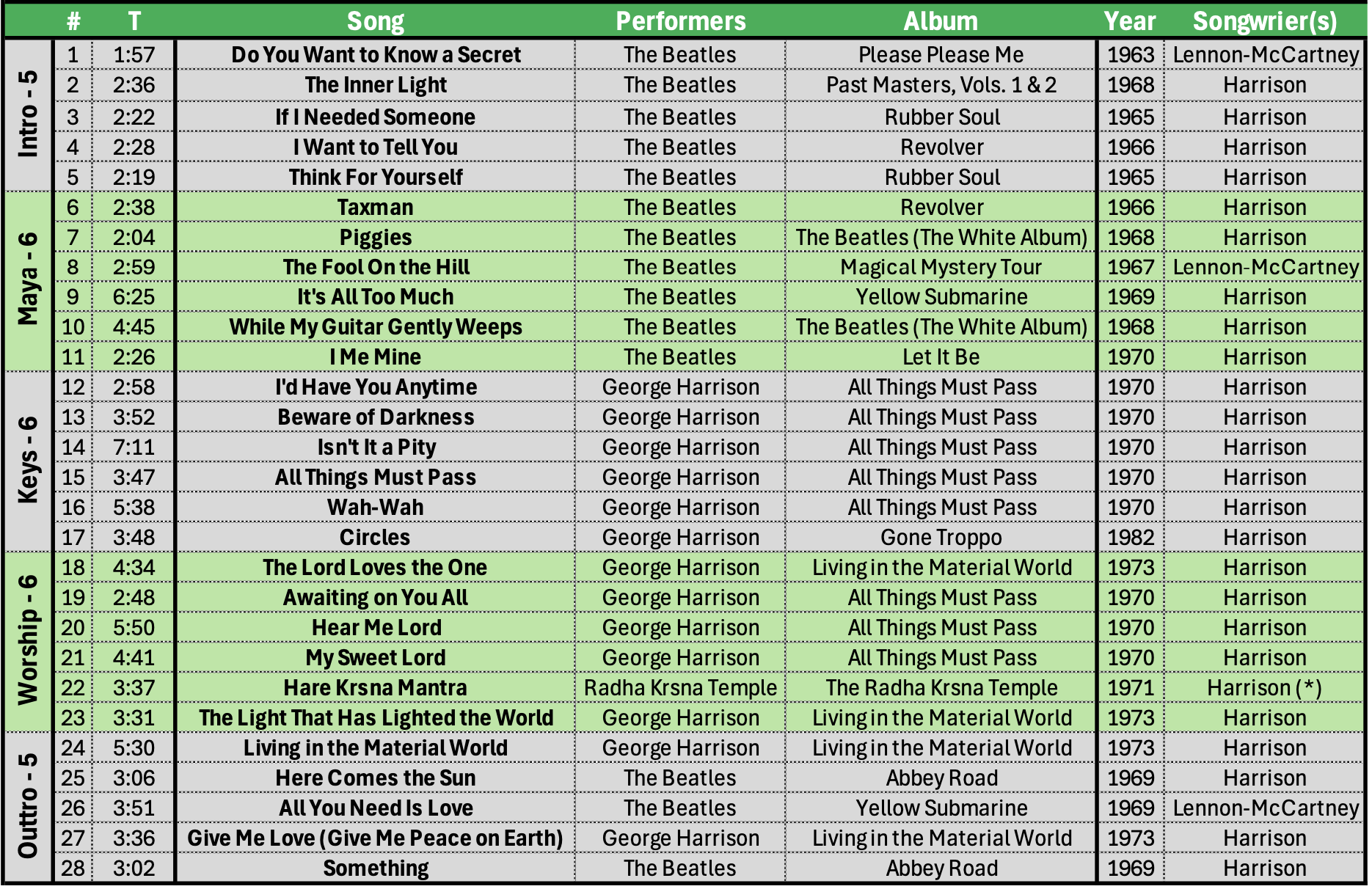
Without any further ado, below is the "Outer Temple" playlist which is also available via Apple Music (preferred) and Spotify (I've received feedback that the stereo balance is out of whack, YMMV):
The playlist runs twenty-eight tracks across five movements, and it is sequenced deliberately. Act I (Intro) is an invitation – "Do You Want to Know a Secret" is the oldest question in the mystery tradition, packaged as a love song. Act II (Maya) is the diagnosis: you are living inside an illusion, and here is what it looks like from the outside. Act III (Keys) is the philosophy – this is where the solo Harrison material begins, and the shift in gravity is immediate. Act IV (Worship) is where the argument stops and the experience starts; My Sweet Lord is not a song about God, it is a Western mantra. Act V (Outtro) is the return – Campbell's hero doesn't stay in the underworld. Something comes back with you. It ends with a man looking at an ordinary human face and seeing something he cannot explain, which is maybe the highest teaching there is. Long time fans of Guru Harrison will recognize patterns while neophytes may just be introduced to mind-blowing music. This is an "Outer Temple," which means there must be an "Inner Temple," right? |
Temple of George Harrison |
|
The Beatles – more famous than Jesus? Think about the amount of $whatever associated with them – money spent, energy spent, eyeballs viewed, etc. – and it's staggering and larger than most, if not all, organized Religions. In terms of collective consciousness, is anything else bigger? John, Paul, George, and Ringo spent their early years (pre-1964) perfecting music that made people go crazy emotionally, then went to India and fully immersed themselves in eastern thought. Ravi Shankar taught them, mostly George, how to communicate feeling in music. The seven albums produced after these two things – Rubber Soul / Revolver, Sgt. Pepper's Lonely Hearts Club Band / Yellow Submarine, The White Album, Abbey Road, and Let It Be – are some of the best albums of all time by any measure. One of the last songs they recorded as The Beatles was I Me Mine – do a deep dive on that song and you get the point-of-view from George Harrison, who was dissolving his ego while transcending capitalism and materialism. The egos he may have been writing the song about were Paul McCartney and John Lennon – two of the most prolific songwriters of all time, who he learned from. One reason he left the band was he had a growing backlog of songs that would have taken an eternity to produce in The Beatles, which came out a few years later as All Things Must Pass – an album which contains the refined and combined wisdom of George and The Beatles. Many years later, in 2011, George Harrison: Living In the Material World, a documentary film co-produced and directed by Martin Scorsese was released. The Beatles, and George Harrison, were singing and yelling the secrets to life directly to the world, and nobody was listening because they were "stuck on the metaphors," and because the message is encoded through their library of music, and one must find it to empower it. Thank goodness to Guru George, who left us breadcrumbs! What Harrison did – which very few people have done at that scale – is what the Greeks called the Orphic transmission. Orpheus descended into the underworld and came back with music. Harrison descended into the most successful entertainment machine in human history and came back with the Vedas encoded in pop songs. He went inward when every incentive was to stay on the surface. While My Guitar Gently Weeps was a lament for the sleeping world. My Sweet Lord was a mantra. All Things Must Pass was a teaching on impermanence so clear a child could absorb it without knowing what they'd absorbed. That's the Orphic transmission. Not doctrine. Not argument. Music. |
One Journey. Many Doors. Same House. |
|
Aldous Huxley spent his career documenting what every serious mystic in every tradition independently stumbled into: the same room. Different doors, different keys, different names for the room – beatific vision, fana, samadhi, satori – but the room is the same. It's the most interesting thing almost nobody knows. Every tradition has two layers. There's the public one: the institution, the doctrine, the rules, the building on the corner. It's genuinely useful – community, ethics, the accumulated wisdom of a lot of people who came before you – and most of us stop there and assume that's the whole thing. Then there's the other layer, the part that doesn't fit on a pamphlet: the direct, personal, usually wordless experience the whole tradition was built to point at. Every tradition describes that experience differently and tends to swear its version is the only real one. Read enough of them, from enough angles, and the descriptions start to rhyme. Same report, different language, filed by different people across five thousand years. That's not a reason to believe any one of them. It's a reason to get curious. The finger is not the moon. The playlist is not the point. This website is not the point. The book that grew out of this website is not the point. They are all fingers. One journey. Many doors. Same house. The entry point is your heart. |
|
|
The Transmission Continues |
|
This started as a blog post about a playlist. The playlist became a chapter. The chapter became a book. Love Isn't All You Need is a manifesto for curiosity. It traces the whole arc: taking apart what you were handed and told to believe (which the playlist is already loosening), the uncomfortable things you have to sit with before you can build anything that lasts, the strange fact that every serious tradition keeps pointing at the same place, and finally the seven pillars – the practical infrastructure of a life that doesn't fall over the first time it's tested. And it makes good on the title. Love isn't all you need. It isn't the whole of it. It's the ground the rest has to grow out of. It ends more or less where it started: with a question. Not "what do you believe?" but "what are you curious enough to go find out for yourself?" If this page landed somewhere, that's the door. The book is what's on the other side of it. |
Bibliography (Work In Progress) |
|
|
No affiliate links because I don't want any money - you can find them, or come to my library... |
|
| Author(s) | Title |
| Joseph Campbell | The Hero with a Thousand Faces |
| Aldous Huxley | The Perennial Philosophy |
| Carl Jung | Man and His Symbols |
| James Hillman | Anima: An Anatomy of a Personified Notion |
| Iain McGilchrist | The Master and His Emissary |
| Amanda Knox | Free: My Search for Meaning |
| Eckhart Tolle | The Power of Now |
| Rumi | Selected Poems (Coleman Barks, trans.) |
| Lao Tzu | Tao Te Ching |
| Will & Ariel Durant | The Lessons of History |
| Thomas A. Limoncelli | Time Management for System Administrators: Stop Working Late and Start Working Smart |
| Michael Schiavello | Know Thyself: Using the Symbols of Freemasonry to Improve Your Life |
| Dalai Lama | The Universe in a Single Atom: The Convergence of Science and Spirituality |
| Rupert Sheldrake | The Science Delusion |
| John Vervaeke | Awakening from the Meaning Crisis (YouTube – 50 lectures, free) |
Privacy Policy · Aqua Regia, LLC · DBA Aqua Regia Scriptura